
Toddler Feeding Guides
Iron-Rich Foods for Toddlers: Beat Deficiency and Boost Development
Complete guide to iron-rich foods for toddlers ages 1–3. Iron content by food, absorption tips, deficiency signs, and daily meal ideas to meet the 7mg daily requirement.
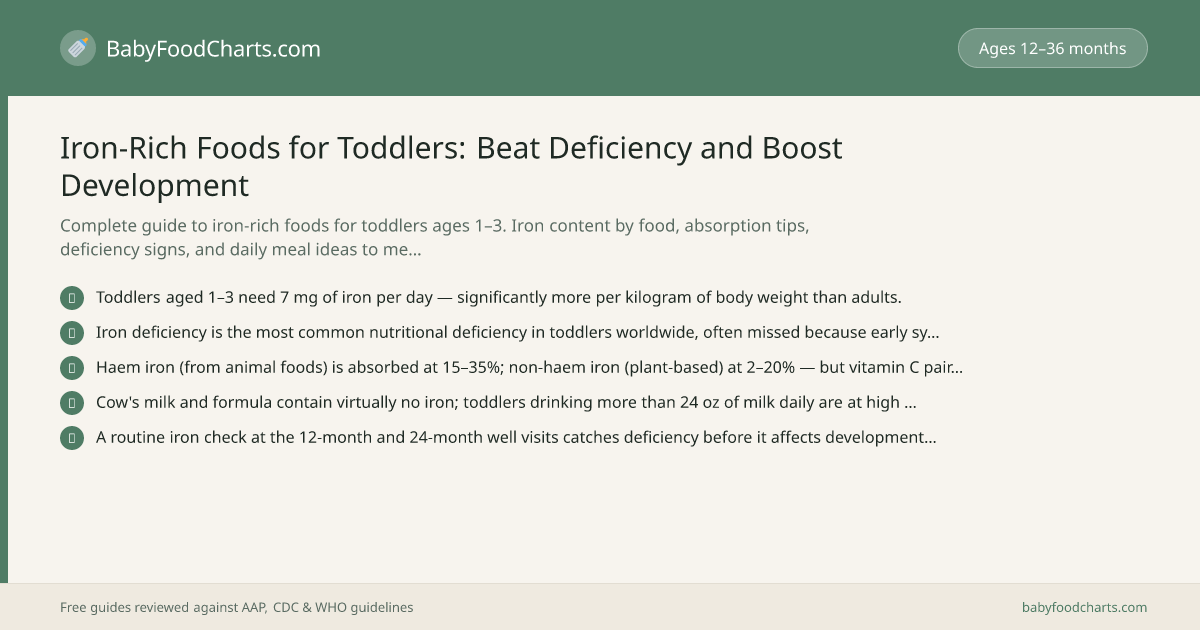

Iron is the most critical and most commonly deficient nutrient in toddlers worldwide. At the first birthday, a perfect storm for iron deficiency arrives: formula (which was iron-fortified) disappears, breast milk provides only trace iron, and cow's milk — which replaces them — contains virtually none. If toddlers also drink more than 24 oz of milk per day, the milk fills their stomach and crowds out the iron-rich solid foods that need to replace it. The result is iron deficiency affecting approximately 9% of toddlers in the United States, with rates higher in food-insecure families and those with high milk consumption.
Why iron matters so much for toddlers
Iron does not just prevent anaemia. It is a critical component of myelin — the protective sheath that insulates neural pathways in the developing brain. Without adequate iron, brain development is compromised in ways that may not be immediately visible but have measurable effects on:
- Cognitive development and learning
- Attention and concentration
- Language acquisition
- Motor skill development
- Emotional regulation
- Immune function
The concerning aspect of iron deficiency is that these effects can persist even after the deficiency is corrected. A toddler who was iron-deficient during the critical 12–24 month window of brain development may show measurable academic and cognitive differences at school age even if iron was repleted before age 3. Early prevention is vastly preferable to later correction.
Iron requirements for toddlers
| Age | Iron RDA | Tolerable Upper Limit | Notes |
|---|---|---|---|
| 7–12 months | 11 mg/day | 40 mg/day | High RDA due to depletion of birth stores |
| 1–3 years | 7 mg/day | 40 mg/day | Must come from food, not formula |
| 4–8 years | 10 mg/day | 40 mg/day | Growth continues to demand iron |
| Adult males | 8 mg/day | 45 mg/day | For comparison |
| Adult females (non-pregnant) | 18 mg/day | 45 mg/day | For comparison |
Toddlers require 7 mg of iron per day. Given their small body size, this is a very high requirement on a per-kilogram basis — higher than that of adult men.
Haem iron: animal-source iron foods
Haem iron comes from the iron in haemoglobin and myoglobin in animal foods. It is absorbed at 15–35% regardless of other factors in the meal, making it the most reliable iron source.
| Food | Serving size (toddler) | Iron content | Notes |
|---|---|---|---|
| Beef (minced/shredded, cooked) | 2 tbsp | 1.2–1.5 mg | Dark red meat has more iron than white |
| Lamb (shredded, cooked) | 2 tbsp | 1.5–2 mg | Highest haem iron per serving |
| Chicken thigh (shredded, cooked) | 2 tbsp | 0.7–1 mg | Dark meat > breast meat for iron |
| Turkey (dark meat, shredded) | 2 tbsp | 1–1.2 mg | Good alternative to chicken |
| Salmon (canned or cooked, flaked) | 2 tbsp | 0.5–0.7 mg | Also excellent for DHA |
| Sardines (canned, drained) | 2 tbsp | 1.5–2 mg | Outstanding iron and calcium source |
| Egg yolk | 1 yolk | 0.6 mg | Less haem iron than meat but still contributes |
| Whole egg (scrambled) | 1 egg | 0.9 mg | Accessible for all toddler diets |
Red meat priority: Beef and lamb contain the highest haem iron content of any common toddler food. Offering red meat 2–3 times per week makes it significantly easier to meet the 7 mg daily target. Meat does not need to be offered in large quantities — even 2 tablespoons of minced beef contributes over 1 mg of highly absorbable iron.
Non-haem iron: plant-source iron foods
Non-haem iron is found in plant foods, fortified foods, and eggs. It is absorbed less efficiently (2–20%) than haem iron, but absorption can be significantly enhanced with simultaneous vitamin C intake.
| Food | Serving size (toddler) | Iron content | Absorption enhancement |
|---|---|---|---|
| Iron-fortified toddler cereal | 1/4 cup (4 tbsp) | 4–8 mg | High — pair with orange or strawberry |
| Iron-fortified baby oatmeal | 3 tbsp cooked | 4–6 mg | High — pair with vitamin C fruit |
| Lentils (cooked) | 3 tbsp | 1.5–2 mg | Good — pair with tomato sauce |
| Chickpeas (cooked, soft) | 3 tbsp | 1–1.5 mg | Good — pair with lemon juice |
| Black beans (cooked) | 3 tbsp | 1–1.5 mg | Good — pair with tomato or capsicum |
| Tofu (firm, cubed) | 3 tbsp | 1.5–2 mg | Good — pair with broccoli or capsicum |
| Pumpkin seeds (ground) | 1 tsp | 0.5 mg | Moderate — ground to prevent choking |
| Quinoa (cooked) | 3 tbsp | 1 mg | Moderate — good protein + iron combo |
| Spinach (cooked) | 1 tbsp | 0.7 mg | Moderate — oxalates reduce absorption |
| Fortified pasta (whole grain) | 3 tbsp cooked | 1–2 mg | Check label for iron fortification |
| Tempeh (soft) | 2 tbsp | 1–1.5 mg | Excellent fermented soy source |
| Dried apricots (rehydrated, soft) | 2–3 pieces | 0.5 mg | Moderate sugar content |
Vitamin C pairing: the iron multiplier
The most important nutritional strategy for increasing iron absorption from plant foods is pairing them with vitamin C (ascorbic acid) in the same meal. Vitamin C converts ferric iron (Fe³⁺) to ferrous iron (Fe²⁺), the form that is actively absorbed by intestinal cells.
Research finding: A single 75 mg dose of vitamin C (roughly the amount in 1/4 cup of capsicum or 5 strawberries) can increase non-haem iron absorption by 2–3 times.
| Food | Toddler serving | Vitamin C |
|---|---|---|
| Red capsicum (capsicum/bell pepper), cooked | 1 tbsp pieces | 35 mg |
| Strawberries (quartered) | 4–5 pieces | 28 mg |
| Kiwi fruit (soft cubes) | 2 tbsp | 35 mg |
| Broccoli (steamed florets) | 3 florets | 25 mg |
| Orange segments | 2 tbsp | 25 mg |
| Tomato (soft, deseeded pieces) | 1 tbsp | 10 mg |
| Cooked peas | 1 tbsp | 8 mg |
| Cauliflower (steamed) | 2–3 florets | 12 mg |
Practical pairing examples:
- Lentil soup + tomato-based broth = iron + vitamin C
- Iron-fortified oatmeal + quartered strawberries = iron + vitamin C
- Scrambled egg + soft-cooked capsicum pieces = iron + vitamin C
- Hummus on toast + broccoli as a dipper = iron + vitamin C
- Black bean tacos + tomato salsa = iron + vitamin C
What blocks iron absorption
Several dietary factors reduce iron absorption and should be separated from iron-rich meals where possible:
Calcium and cow's milk: Calcium competes with iron for absorption at the same intestinal transporter. Serving 6+ oz of milk at the same meal as the highest iron component of the day reduces absorption. Offer milk as a second course or after the iron-rich part of the meal.
Tannins (tea and coffee): Tannins in black tea, green tea, and coffee strongly inhibit iron absorption. Never offer these to toddlers, and parents feeding toddlers should be aware that if a toddler takes a sip of tea alongside their meal, it affects iron absorption.
Phytates: Found in whole grains, legumes, and nuts. Phytates bind non-haem iron and reduce absorption. Soaking legumes before cooking, using yeast-risen bread (fermentation reduces phytates), and not over-relying on raw grain foods all reduce this effect.
Polyphenols in cocoa and some plants: Moderate inhibitory effect. Not a significant concern in toddler diets at normal intake levels.
Signs of iron deficiency to watch for
Iron deficiency in toddlers progresses through stages:
Stage 1 (Iron depletion): Iron stores in the bone marrow decrease. No visible symptoms. Blood tests show low serum ferritin.
Stage 2 (Iron-deficient erythropoiesis): Red blood cell production becomes iron-limited. Haemoglobin levels begin to drop slightly. Still no obvious symptoms in most toddlers.
Stage 3 (Iron deficiency anaemia): Haemoglobin falls below 11 g/dL. Symptoms become apparent: pallor (pale skin), fatigue, reduced appetite, irritability, frequent infections, poor growth.
Watch for:
- Pallor around the eyes (inner eyelid), lips, and fingernails
- Pale or greyish skin tone
- Unusual fatigue or low energy compared to peers
- Persistent poor appetite despite a reasonable feeding schedule
- Frequent colds and infections
- Developmentally, falling behind in language or motor milestones
- Pica (eating non-food items like dirt, clay, paint chips) — a classic sign of iron deficiency
If you notice these signs, request an iron check from your pediatrician. Do not wait for the next scheduled well visit.
Sample daily meal plan hitting 7mg iron
Here is how to build a day that reaches or exceeds 7 mg of iron through food:
| Meal | Iron-rich foods | Approx. iron |
|---|---|---|
| Breakfast | Iron-fortified oatmeal (3 tbsp) + quartered strawberries | 4–5 mg |
| Morning snack | Full-fat yogurt + blueberries (trace iron) | 0.2 mg |
| Lunch | Lentil soup (3 tbsp lentils) + tomato-based broth + soft bread | 1.5–2 mg |
| Afternoon snack | Cheese + soft fruit (trace iron) | 0.2 mg |
| Dinner | 2 tbsp minced beef + 2 tbsp soft pasta + steamed broccoli | 1.5 mg |
| Daily total | — | ~7.5–8.5 mg |
This day achieves the 7 mg RDA through a combination of fortified cereal (the iron workhorse), legumes, and red meat. The vitamin C pairings (strawberries with oatmeal, tomato in lentil soup, broccoli with beef) ensure the plant-based iron is being efficiently absorbed.
Iron for toddlers on plant-based diets
Vegetarian and vegan toddlers can absolutely meet their iron needs, but it requires more intentional planning. Without haem iron from meat, non-haem iron must carry the full load — meaning vitamin C pairing at every iron-containing meal is non-negotiable, and fortified foods become even more important.
Vegetarian iron strategy:
- Iron-fortified cereal at breakfast every day (4–8 mg per serving)
- Legumes at lunch and dinner (lentils, chickpeas, black beans)
- Vitamin C at every meal with iron-containing foods
- Tofu and tempeh as protein sources (both contain iron)
- Discuss with a paediatric dietitian to confirm adequacy
Vegan toddlers additionally need:
- Vitamin B12 supplementation (found only in animal foods)
- DHA supplementation (algae-based)
- Calcium monitoring (if not consuming dairy or fortified plant milk)
- Regular iron checks
Routine iron screening at 12 and 24 months is the best tool for catching iron deficiency before it affects development. Combine it with the iron-rich diet strategies above, and toddler iron deficiency becomes very preventable.
Frequently asked questions
How much iron does a toddler need per day?
Toddlers aged 1–3 need 7 mg of iron per day (Recommended Dietary Allowance). This is a high requirement relative to their small body size. For context: 2 tablespoons of cooked beef provides approximately 1 mg of haem iron, and 3 tablespoons of lentils provides approximately 2 mg of non-haem iron.
What are signs of iron deficiency in toddlers?
Early signs of iron deficiency in toddlers include: pale skin (especially around the eyes, lips, and fingernails), fatigue and low energy, decreased appetite, frequent infections, irritability, poor concentration, and developmental delays. By the time anaemia is visible, the deficiency has usually been present for months.
Does my toddler need an iron supplement?
Most toddlers eating meat, eggs, legumes, and iron-fortified cereals do not need an iron supplement. The AAP recommends routine iron screening at 12 months; if deficiency is found, iron drops or a multivitamin with iron is prescribed. Do not supplement iron routinely without testing — excess iron is toxic.
What vitamin helps iron absorption?
Vitamin C (ascorbic acid) increases non-haem iron absorption by 2–3 times when consumed in the same meal. Best vitamin C sources for toddlers: strawberries, kiwi, orange segments, capsicum (red pepper), tomatoes, broccoli, and cooked peas. Build a habit of pairing these with every iron-containing plant food.
Does cow's milk block iron absorption?
Yes. Cow's milk contains calcium and casein that inhibit iron absorption when consumed at the same meal. This is a secondary reason to limit milk to 16–24 oz per day (the primary reason being milk displacing iron-rich solid foods). Offer milk separately from the most iron-rich component of the meal when possible.
Which is better — haem or non-haem iron for toddlers?
Both contribute meaningfully to iron status. Haem iron (from meat, poultry, and fish) is more efficiently absorbed but cannot be maximised beyond its serving size. Non-haem iron (from plants and fortified foods) is less efficiently absorbed but can be significantly enhanced with vitamin C pairing. A diet containing both is ideal.
Sources & references
- Iron Deficiency in Young Children, CDC
- Iron Deficiency Anemia in Children, HealthyChildren.org — AAP
- Dietary Reference Intakes for Iron, National Academies — Institute of Medicine
- Vitamin C and Iron Absorption, American Journal of Clinical Nutrition
- WHO: Iron Deficiency Anaemia, World Health Organization
BabyFoodCharts Editorial Team
Reviewed against current pediatric feeding guidance
Our editorial team researches and reviews every guide for accuracy and clarity. This content is educational and is not a substitute for advice from your own pediatrician.
Browse these topics
Related articles
Continue reading
Read nextPicky Eater Toddler Guide: Evidence-Based Strategies That Actually WorkRecently updated
Note: BabyFoodCharts provides general educational information. It is not medical advice. Consult your pediatrician before introducing new foods, especially common allergens.