
Toddler Feeding Guides
Picky Eater Toddler Guide: Evidence-Based Strategies That Actually Work
Science-backed strategies for picky eater toddlers ages 1–3. Learn the Division of Responsibility, exposure science, and what actually works from pediatric feeding research.
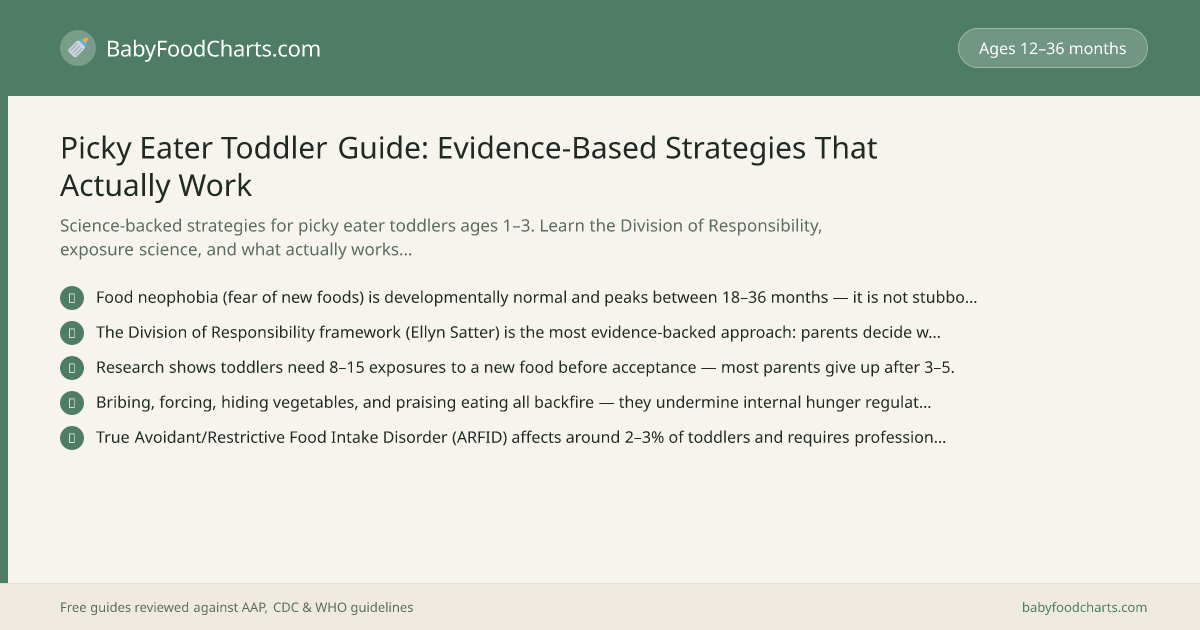

Almost every parent of a toddler has been there: the carefully prepared plate of nutritious food gets pushed away, thrown, or met with a look of pure betrayal. Picky eating is the single most common feeding concern that parents bring to pediatricians in the toddler years — and the good news is that most of it is both normal and addressable with the right strategies. The research on what actually works may surprise you, because most of the instinctive parental responses to picky eating make it worse.
What is food neophobia and why do toddlers have it?
Food neophobia — literally "fear of new foods" — is the instinctive rejection of unfamiliar foods. It is not pickiness in the pejorative sense. It is a developmentally programmed response.
The evolutionary theory is straightforward: when toddlers became mobile enough to explore independently (around 12–18 months), they also became capable of encountering toxic plants and fungi. A hard-wired caution toward novel foods would have been strongly protective in a pre-agricultural world. Toddlers who refused unknown foods survived to reproduce; those who ate anything did not.
This explains why food neophobia:
- Peaks between 18 and 36 months — exactly when toddlers are most independently mobile
- Is universal across human cultures
- Targets unfamiliar foods more than familiar ones
- Improves dramatically with repeated, pressure-free exposure
Understanding that your toddler's food refusal is a feature of normal brain development rather than a character flaw changes the emotional experience of mealtimes significantly.
The Division of Responsibility framework
The most rigorously evidenced framework for toddler feeding comes from dietitian Ellyn Satter, who developed it over decades of clinical work. The Division of Responsibility (sDOR) has been validated in multiple randomised controlled trials and is endorsed by the Academy of Nutrition and Dietetics.
The framework is simple:
Parent's job:
- What food is offered (the menu)
- When food is offered (the schedule)
- Where food is offered (at the table, sitting down)
Toddler's job:
- Whether to eat
- How much to eat
That is the entire framework. Parents do not control how much toddlers eat, and toddlers do not control what appears on the table.
Why this works
When parents try to control toddler intake (using pressure, bribes, force, or special alternatives), they interrupt the toddler's internal hunger and fullness regulation. Toddlers who are pressured to eat more than they want become desensitised to fullness signals — a mechanism linked to overeating and obesity in later life. Toddlers who are allowed to skip food they dislike learn that refusal gets them the preferred alternative — and the range of accepted foods shrinks.
The sDOR removes both of these dynamics. The parent's job is to consistently put nutritious food on the table at regular times. The toddler's job is to eat it or not. Both do their job without interfering with the other's domain.
The exposure science: 8–15 times is not a myth
Research by psychologist Leann Birch and replicated in multiple subsequent studies shows that toddlers need 8–15 exposures to a new food before they are likely to accept it. Most parents abandon a new food after 3–5 rejections and conclude the toddler dislikes it.
What counts as an exposure:
- Having the food on the plate (even if untouched)
- Smelling the food
- Touching or poking the food
- Licking the food
- Tasting and spitting it out
Any interaction with the food counts. A toddler who pushes broccoli off their plate has had a broccoli exposure. Keep serving it.
The key rule: Never comment on the rejection. Do not express disappointment, do not praise effort ("good job tasting it!"), do not remove the food dramatically. Just note it internally as exposure number 4 of 15, and move on.
What works: evidence-based strategies
1. Consistent family meals
Toddlers learn to eat what the adults around them eat. Sitting at a family table and observing parents and siblings eating a variety of foods is one of the most powerful food acceptance tools available. Social learning — watching others eat a food with apparent enjoyment — is more effective than any persuasion technique.
Implementation: Eat at least one meal per day as a family, at the table, with everyone eating the same food. Turn off screens. Talk about anything except food.
2. Food chaining
Food chaining is a structured approach used by occupational therapists and dietitians: starting from an accepted food and making tiny incremental changes until the target food is reached.
Example chain toward accepting broccoli:
- Green peas (already accepted)
- Edamame (similar texture, shape, colour)
- Broccoli mixed with peas
- Broccoli alongside peas
- Broccoli as the primary vegetable
Each step is introduced only once the current step is fully accepted. The process may take months — this is acceptable.
3. Food play and sensory exploration
Before a toddler can eat a food comfortably, they need to be comfortable with how it looks, feels, and smells. Sensory play with food — not at mealtimes — reduces the novelty and threat of unfamiliar foods.
Activities:
- Sorting foods by colour (tomatoes in the red pile, broccoli in the green pile)
- Washing vegetables in the sink
- Stamping with cut vegetables (potato stamp printing)
- Tearing salad greens into small pieces
- Mashing soft foods with hands
Children who play with foods they do not yet eat typically become willing to taste them sooner than children with no food play exposure.
4. Toddler involvement in food selection and preparation
Research consistently shows that toddlers eat more willingly when they have been involved in choosing or preparing the food. This does not require elaborate cooking projects.
Age-appropriate involvement:
- 12–18 months: choosing between two options at the supermarket (banana or mango?)
- 18–24 months: washing fruit, tearing lettuce, stirring pancake batter
- 2–3 years: adding ingredients to a pot, peeling soft-cooked eggs, setting the table
The investment of ownership in the meal changes the toddler's relationship to it.
5. Flavour-flavour learning
Toddlers accept foods more readily when they are associated with flavours they already enjoy. This is different from hiding — it is learning.
Examples:
- Adding a tiny amount of full-fat coconut milk to a vegetable stew (sweet + creamy bridges the familiar to the unfamiliar)
- Serving broccoli with a small amount of grated cheddar (familiar cheese flavour + unfamiliar vegetable)
- Adding avocado to a mango smoothie (sweet mango bridges the toddler toward avocado)
The key is that both foods are visible on the plate or in the dish — the toddler is not deceived, just supported in their transition.
What does not work (and why)
Forcing eating
Physical or psychological pressure to eat increases food refusal. Research shows that children who are pressured to eat vegetables at ages 2–3 eat fewer vegetables at ages 7–10 than children whose vegetable eating was never pressured. Pressure creates negative associations with the food and with mealtimes, exactly the opposite of the intended effect.
Bribing with dessert
"Eat your vegetables and you can have ice cream" is one of the most well-studied strategies in child feeding research — and one of the most reliably counterproductive. Numerous studies show it reliably decreases liking for the vegetable and increases preference for the dessert. The message toddlers internalise is: vegetables are something to be endured to get to the good stuff.
The alternative: serve dessert as a regular, small part of the meal or offer it separately with no connection to vegetable consumption.
Making separate toddler meals
When refusal earns a preferred alternative (macaroni cheese when the family dinner is rejected), toddlers learn that refusal is an effective strategy. The range of accepted foods at family meals gradually shrinks as toddlers optimise for preferred foods. Offer the family meal, include one accepted element, and let the rest be the toddler's choice.
Hiding vegetables
Serving vegetable-rich pasta sauce does not build any vegetable acceptance. A toddler who only eats vegetables in disguised form is not learning to recognise, like, or willingly choose vegetables. Serve vegetables visibly and consistently, and track that as the real goal.
Praise for eating
Telling a toddler "good job eating your broccoli!" seems harmless but disrupts internal hunger regulation in the same way bribing does. Eating becomes about earning praise rather than responding to hunger — an externalisation of appetite that interferes with the internal regulation we want toddlers to develop.
Instead: neutral, warm mealtimes where food is enjoyed without performance.
Managing the neophobia peak (18–36 months)
Between 18 and 36 months, food neophobia peaks and most toddlers show their most selective eating. The strategies above remain the same during this phase — consistent, positive, pressure-free exposure — but expectations need adjusting.
What is realistic during peak neophobia:
- Your toddler may reject 80–90% of what is offered at any given meal
- Accepted foods may drop from 20 to 15 to 10
- Foods previously accepted may be suddenly refused ("food jag rejection")
- The same food in a different bowl or cut differently may be refused
None of this requires intervention — it is temporary. The key is not reducing variety in response to refusal. Toddlers who are offered a narrow range of foods during the neophobia peak emerge from it with a narrow diet. Those offered a wide variety — even if mostly rejected — emerge with much broader acceptance.
Food jag rejection
A "food jag" is when a toddler becomes obsessed with eating one food repeatedly (e.g., peanut butter sandwiches at every meal for two weeks). The jag eventually ends and the toddler refuses the once-loved food entirely. This is normal. Do not panic, do not stop offering the food — just continue normal variety.
Building a long-term positive relationship with food
The goal of toddler feeding is not just getting adequate nutrition into your toddler this week. It is building a relationship with food — curiosity rather than fear, pleasure rather than performance, internal responsiveness to hunger and fullness rather than external control.
These are the attributes that predict healthy eating patterns through adolescence and adulthood. They are built not with clever strategies or nutritional optimisation, but with consistent, calm, positive family mealtimes where food is enjoyed without drama.
Picky eating in toddlers is not a parenting failure. It is an invitation to get the structure right, lower the pressure, expand the variety of what is on offer, and trust the process. It almost always gets better.
Frequently asked questions
Is it normal for toddlers to be picky eaters?
Yes, extremely common. Food neophobia (fear or rejection of new foods) is a developmentally normal phase that typically peaks between 18 and 36 months. It is thought to be an evolutionary protective mechanism — toddlers who could walk independently avoided novel foods that might be toxic. It resolves in most children by ages 4–5 with consistent, pressure-free exposure.
How do I get my toddler to eat vegetables?
Offer vegetables at every meal without pressure or comment. Do not remove them because your toddler ignores them — the plate is a social environment and familiarity builds over repeated exposures. Serve vegetables alongside accepted foods. Dips like hummus or avocado increase acceptance. Research shows 8–15 exposures before acceptance is the norm, not the exception.
Should I hide vegetables in my toddler's food?
Hiding vegetables in other foods (puree in pasta sauce, spinach in smoothies) may get vegetables into the body short-term, but does nothing to build actual food acceptance. Toddlers who only eat vegetables disguised in food do not learn to like or recognise vegetables. Serve vegetables visibly and consistently instead.
My toddler only eats 5 foods. When should I worry?
A toddler eating 5–10 foods consistently with reasonable growth is likely within the normal variation range. Talk to your pediatrician if your toddler: is losing weight or not growing, is eating fewer than 5 foods with no improvement over months, shows extreme distress (gagging, crying) at the sight of new foods, or if the limitation is significantly impacting family life.
Does bribing with dessert work?
No, and it backfires. Research consistently shows that making access to a preferred food (dessert) contingent on eating a less preferred food (vegetables) makes toddlers like the vegetable even less over time. It also disrupts internal appetite regulation by using food as reward — a pattern linked to emotional eating in later life.
What is ARFID and how is it different from picky eating?
Avoidant/Restrictive Food Intake Disorder (ARFID) is an eating disorder characterised by extreme food avoidance causing nutritional deficiency, significant weight loss, or major psychosocial impairment. Unlike typical picky eating, ARFID does not improve with standard strategies and requires multidisciplinary treatment (dietitian, occupational therapist, psychologist). It affects 2–3% of children.
Sources & references
- Division of Responsibility in Feeding, Ellyn Satter Institute
- Food Neophobia in Early Childhood, Nutrients Journal — NIH
- Repeated Exposure and Food Acceptance, Birch & Marlin, Appetite Journal
- ARFID Diagnostic Criteria, National Eating Disorders Association
- Feeding Difficulties in Young Children, HealthyChildren.org — AAP
BabyFoodCharts Editorial Team
Reviewed against current pediatric feeding guidance
Our editorial team researches and reviews every guide for accuracy and clarity. This content is educational and is not a substitute for advice from your own pediatrician.
Browse these topics
Related articles
Continue reading
Read nextBest Foods for Toddler Brain Development: DHA, Choline & MoreRecently updated
Note: BabyFoodCharts provides general educational information. It is not medical advice. Consult your pediatrician before introducing new foods, especially common allergens.