
Food Safety
Foods to Avoid for Babies Under 12 Months: Complete List
Some foods are dangerous for babies under 12 months. See our complete list of foods to avoid (honey, whole nuts, raw vegetables, and more) with the reasons why and safe alternatives.
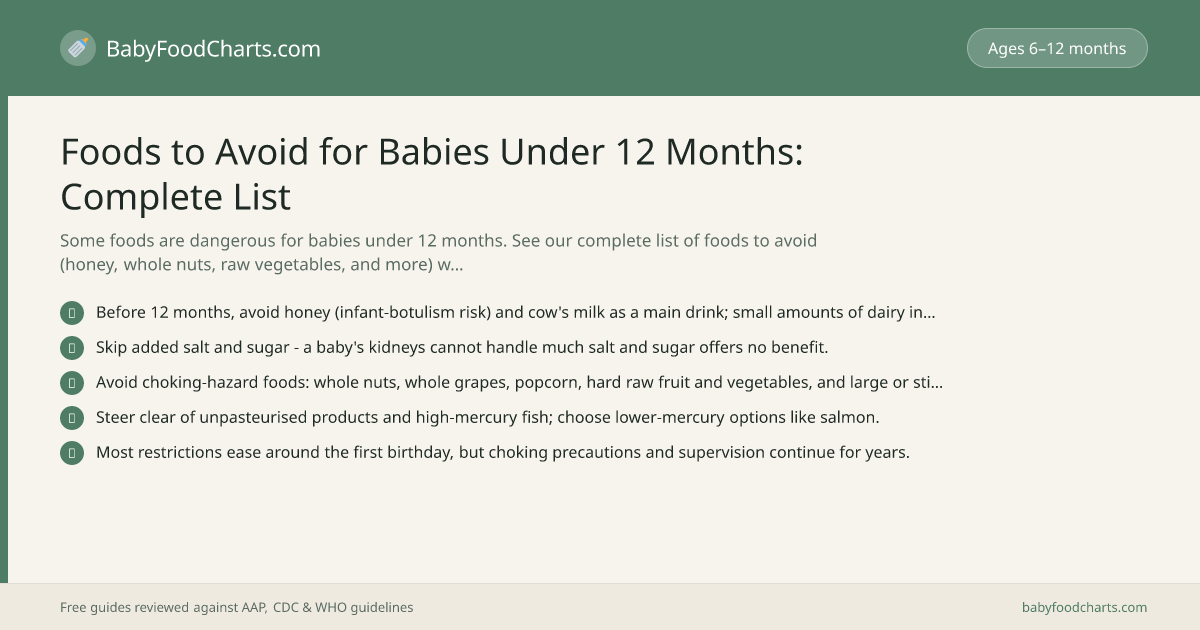

Before your baby turns one, a short list of foods should stay off the menu: honey, cow's milk as a main drink, added salt and sugar, common choking-hazard foods, unpasteurised products, high-mercury fish, and rice drinks. Most of these cautions are temporary and reflect your baby's developing gut, kidneys, and airway, not a reason to feel anxious about feeding.
Starting solids is exciting, and the vast majority of foods are safe and encouraged. This guide focuses on the small number of foods that genuinely warrant caution in the first year, and the safer ways to handle them. As always, your pediatrician knows your baby best and should guide any decisions specific to your family.
Honey and the risk of infant botulism
Honey can contain dormant spores of Clostridium botulinum. In an older child or adult these spores pass through harmlessly, but a baby's immature digestive system can let them grow and produce a toxin that causes infant botulism, a rare but serious illness affecting the muscles and breathing.
Cow's milk as a main drink
Whole cow's milk used in cooking, stirred into mashed potato, a white sauce, or oatmeal, is fine from around 6 months. The caution is about cow's milk as your baby's main drink before 12 months. It is low in iron and can displace the breast milk or formula that provides the iron and nutrition your baby needs. Iron is especially important from 6 months onward, so prioritise iron-rich solids alongside breast milk or formula.
Added salt and sugar
A baby's kidneys cannot process much sodium, and early exposure to very sweet or salty tastes can shape later preferences.
| Food / hazard | Why | Safer approach |
|---|---|---|
| Added table salt | Strains immature kidneys; daily limit is under 1 g salt | Season your own portion after serving baby's; use herbs for flavour |
| Salty processed foods (bacon, stock cubes, some sauces) | High hidden sodium | Choose low-salt or no-salt-added versions; check labels |
| Added sugar and sweetened drinks | Risk to emerging teeth; trains a sweet preference | Sweeten with mashed banana or other fruit instead |
| Honey as a sweetener | Botulism risk under 12 months | Avoid entirely until after the first birthday |
Choking-hazard foods
Some foods are the right size and shape to block a small airway. These need to be modified rather than avoided forever, most can be served safely with simple preparation.
Unpasteurised products
Unpasteurised (raw) milk and the soft cheeses sometimes made from it can carry bacteria such as Listeria, Salmonella, and E. coli that are particularly dangerous for babies. Avoid raw milk, mould-ripened soft cheeses (like brie and camembert), and blue-veined cheeses unless they are cooked until steaming hot. Pasteurised full-fat hard cheeses and pasteurised plain yogurt are good, safe choices.
High-mercury fish
Fish is a wonderful food for babies, oily fish like salmon supplies omega-3 fats and lower-mercury options support healthy growth. The concern is specifically with fish that accumulate high levels of mercury, which can affect a developing nervous system.
| Food / hazard | Why | Safer approach |
|---|---|---|
| Shark, swordfish, marlin, king mackerel | Highest mercury levels | Avoid for babies and young children |
| Bigeye and large albacore tuna | Moderately high mercury | Limit; prefer light tinned tuna in small amounts |
| Salmon, sardines, light tuna, cod | Lower mercury, good nutrition | Cook thoroughly; remove all bones; flake finely |
Rice drinks
Rice drinks (rice "milk") should not be given to children under 5 as a milk substitute because they can contain higher levels of arsenic. If your baby needs a milk alternative for medical or dietary reasons, your pediatrician or a dietitian can recommend a suitable, fortified option.
A quick reassurance
This list can look long, but it is short compared with the huge range of foods your baby can enjoy, iron-rich meats and lentils, well-cooked egg, plain yogurt, mashed fruit and vegetables, and soft flaked salmon among them. Offer a variety of safe textures and flavours, keep mealtimes calm and positive, and lean on your pediatrician for the questions specific to your child.
Finally, because choking is a real risk in this age group, consider taking an infant first-aid and CPR course. Knowing what to do, and being able to call your local emergency services without hesitation, brings real peace of mind.
Frequently asked questions
Why can't babies under 1 have honey?
Honey can contain spores of Clostridium botulinum, which can grow in a baby's immature gut and cause infant botulism, a serious illness. This applies to raw, pasteurised, and cooked honey, so avoid it entirely until after the first birthday.
Can babies have cow's milk before 12 months?
Small amounts of whole cow's milk used in cooking, such as in mashed potato or a sauce, are fine from around 6 months. What to avoid is cow's milk as your baby's main drink before 12 months, because it does not provide enough iron and can displace breast milk or formula.
Is added salt really a problem for babies?
Yes. A baby's kidneys cannot handle much sodium. Babies under 12 months should have less than 1 gram of salt (about 0.4 g sodium) per day, so avoid adding salt and limit salty processed foods.
Which fish should babies avoid?
Avoid high-mercury fish such as shark, swordfish, king mackerel, marlin, and bigeye tuna. Lower-mercury options like salmon and light tinned tuna in moderation are generally fine, check current local advice with your pediatrician.
Are rice drinks safe for babies?
No. Rice drinks should not be given to children under 5 as a main milk substitute because of arsenic levels. Always speak to your pediatrician about appropriate milk alternatives.
What about whole grapes and nuts?
Whole grapes, whole nuts, popcorn, and other round or hard foods are choking hazards. Quarter grapes lengthwise and offer nuts as smooth nut butter thinned with water or milk rather than whole.
When can my baby have these foods?
Most restrictions, honey, cow's milk as a drink, whole nuts, relax around the first birthday, but choking precautions continue for years. Always confirm timing with your pediatrician.
Sources & references
- Foods and Drinks to Avoid or Limit, Centers for Disease Control and Prevention
- Choking Hazards, Centers for Disease Control and Prevention
- Your baby's first solid foods, NHS
BabyFoodCharts Editorial Team
Reviewed against current pediatric feeding guidance
Our editorial team researches and reviews every guide for accuracy and clarity. This content is educational and is not a substitute for advice from your own pediatrician.
Browse these topics
Related articles
Continue reading
Read nextHow to Introduce Allergens to Baby: Safe and Early Introduction GuideRecently updated
Note: BabyFoodCharts provides general educational information. It is not medical advice. Consult your pediatrician before introducing new foods, especially common allergens.