
Toddler Feeding Guides
2 Year Old Food Chart: Complete Meal Plan, Portions & Best Foods
Complete 2-year-old food chart with daily portions, sample menus, best foods by group, and nutritional priorities for ages 24 months. AAP and CDC reviewed.

The second birthday brings a fresh set of nutritional guidelines and a toddler who is, in many ways, a very different eater than they were at 12 months. At 2 years, brain development remains rapid but the primary dietary fat requirement shifts; whole milk gives way to low-fat milk, added sugars must now be actively limited, and portions grow to reflect your toddler's expanding appetite and activity level. This chart translates the guidelines into practical daily eating.
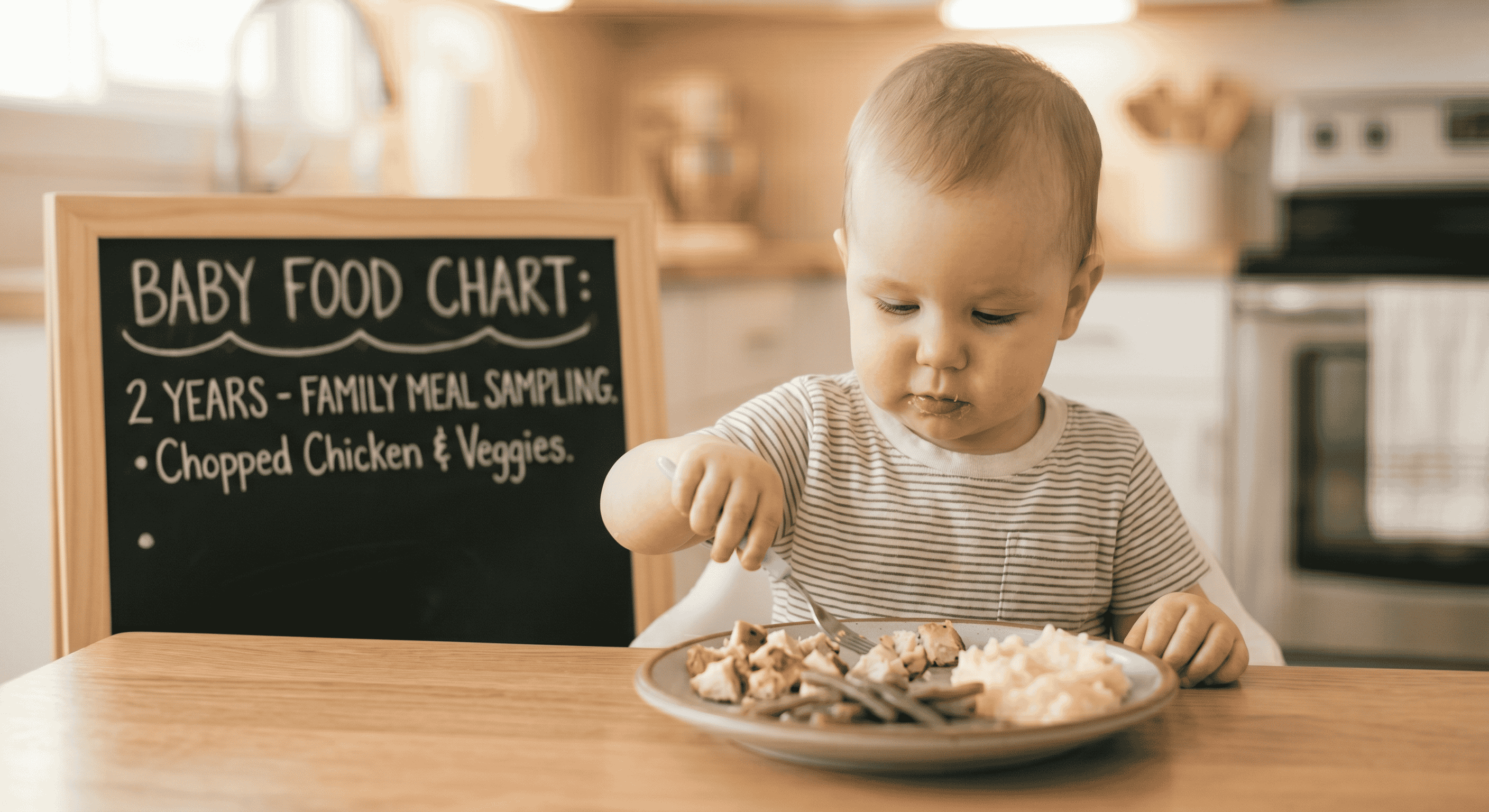
2 Years – Family Meals (Sampling & Utensils)
At 2 years, the toddler has moved from a high chair to a booster seat at the main family dining table. They are now eating a chopped-up version of a standard family meal. The plate holds miniature portions of roasted chicken, soft green beans, and mashed potatoes. The toddler is using a small ceramic plate and a small fork. The background chalkboard, now integrated on a sideboard, reads: "BABY FOOD CHART: 2 YEARS - FAMILY MEAL SAMPLING. Chopped Chicken & Veggies."
What changes at 24 months
The whole milk transition
The single most significant dietary change at 24 months is the milk transition. Whole milk was appropriate from 12 to 24 months because dietary fat was critical for the rapid brain myelination occurring in the second year of life. By 24 months, while brain development continues, the need for the additional fat from whole milk is reduced.
The AAP recommends switching to reduced-fat (2%) or low-fat (1%) milk at age 2 for most children. Whole milk may still be appropriate for lean toddlers who are not getting adequate dietary fat from other sources — discuss with your pediatrician.
Do not switch to skim (non-fat) milk until much later. Fat-soluble vitamins (A, D, E, K) require dietary fat for absorption, and toddlers still need adequate dietary fat for continued brain and nervous system development.
Added sugar limits begin at 2
Before age 2, the recommendation is zero added sugar. From age 2, the American Heart Association sets the limit at 25 g (about 6 teaspoons) of added sugar per day. This is still a relatively strict limit — many commercial toddler snacks, flavoured yogurts, and breakfast cereals can use up most of this budget in a single serving.
Build the habit of reading labels and choosing minimally processed foods. Teaching your 2-year-old to enjoy food with complex, subtle flavours now is a long-term investment.
Growing independence and opinions
Two-year-olds are verbal — they can tell you what they want (and do not want) with increasing specificity. This is developmentally appropriate but can create feeding challenges. The key is not negotiating the menu, but giving choices within the healthy structure you have designed.
"Do you want broccoli or carrots?" works. "Do you want vegetables or crackers?" does not.
2-year-old food chart
| Time | Meal | Sample foods | Portions |
|---|---|---|---|
| 7:30 am | Breakfast | Scrambled egg + whole grain toast + sliced strawberries + low-fat milk | 1 egg, 1/2 slice toast, 2 tbsp fruit, 6 oz milk |
| 10:00 am | Morning snack | Full-fat yogurt + quartered blueberries + rice crackers | 4 oz yogurt, 2 tbsp fruit, 2–3 crackers |
| 12:30 pm | Lunch | Lentil and vegetable pasta + steamed broccoli + water | 3 tbsp pasta + sauce, 3–4 florets |
| 3:00 pm | Afternoon snack | Soft cheese cubes + apple slices (thin, peeled) or soft fruit + water | 2 small cubes, 2–3 slices |
| 6:00 pm | Dinner | Shredded chicken or fish + soft-cooked rice + mixed soft vegetables + milk | 2–3 tbsp each, 6 oz milk |
Portion sizes at 24 months
| Food group | Daily servings | 1 serving at age 2 |
|---|---|---|
| Grains (whole grain preferred) | 4–5 | 3 tbsp cooked pasta or rice; 1/2 slice bread |
| Vegetables | 2–3 | 1/4 cup (4 tbsp) soft-cooked vegetables |
| Fruit | 2 | 1/4 cup (4 tbsp) soft or fresh fruit |
| Protein (meat/fish/egg/legume) | 2 | 2–3 tbsp minced or shredded; 1 egg; 3 tbsp legumes |
| Dairy | 2–3 | 6 oz low-fat milk; 4 oz yogurt; 1 oz cheese |
| Healthy fats | At most meals | 1/4 avocado; 1 tsp nut butter; olive oil drizzle |
Best foods for a 2-year-old by group
Best proteins
Iron-rich proteins take priority. At 2 years, the iron requirement remains 7 mg per day — meeting it requires intentional daily choices.
Animal proteins (serve 2–3 times per week):
- Minced beef or lamb (pasta sauce, tacos, soup)
- Shredded chicken thigh
- Salmon or sardines (twice weekly for DHA)
- Scrambled or hard-boiled egg (daily if possible)
- Canned tuna in water (1 oz per week maximum; use light not albacore)
Plant proteins (alternate daily):
- Lentils (red lentil dhal, soup, mixed into pasta sauce)
- Chickpeas (mashed into hummus, tossed soft in salads)
- Black beans (quesadillas, tacos, rice bowls)
- Tofu (soft cubes, scrambled with egg, added to soup)
- Peanut butter or almond butter (thin spread on toast)
Best vegetables for 2-year-olds
By 24 months, a wider range of vegetable textures becomes manageable. Continue cooking most vegetables until soft, but some softer raw vegetables can now be introduced.
Well-tolerated at 24 months:
- Steamed broccoli florets (most toddlers accept broccoli eventually)
- Roasted sweet potato cubes
- Soft-cooked carrot coins or grated raw carrot
- Avocado (naturally soft)
- Soft-cooked green beans
- Steamed peas
- Roasted butternut squash
- Soft-cooked courgette/zucchini
- Steamed cauliflower
- Lightly sauteed spinach mixed into pasta or eggs
New textures possible at 24 months:
- Very thinly grated raw carrot (in salad or on crackers)
- Soft raw cucumber (deseeded, peeled)
- Soft cherry tomatoes quartered
- Very soft salad leaves
Best fruits
Continue quartering grapes, cherry tomatoes, and whole blueberries. Most other fruits are now manageable in bite-sized pieces.
- Peeled apple slices (soft; very thin slices are safer than thick chunks)
- Banana (now safe in larger coin-sized pieces)
- Quartered strawberries or sliced
- Mango cubes
- Soft pear pieces
- Kiwi (excellent vitamin C — 70 mg per half kiwi)
- Watermelon cubes (seedless)
- Peach or nectarine pieces (skin off)
Best dairy at 24 months
Switch: Whole milk → low-fat (1–2%) milk at the second birthday for most children.
- Low-fat cow's milk: 16–20 oz per day
- Full-fat yogurt OR low-fat yogurt (both appropriate)
- Soft cheese: cheddar, mozzarella, cottage cheese, ricotta
- Kefir (plain, full-fat)
Best grains
- Iron-fortified toddler oatmeal (excellent iron source — continue daily)
- Whole grain bread or toast
- Whole wheat pasta
- Brown rice or white rice (both fine)
- Quinoa (protein + iron)
- Whole grain crackers
- Soft wholemeal pitta
Sample 2-year-old daily menu
Breakfast:
- 1 scrambled egg with soft-cooked spinach
- 1/2 slice whole grain toast with thin peanut butter spread
- Sliced strawberries (4–5 slices)
- 6 oz low-fat milk
Morning snack:
- 4 oz full-fat yogurt with quartered blueberries and iron-fortified cereal (1 tbsp stirred in)
Lunch:
- 3 tbsp soft pasta with lentil and tomato bolognese
- 3–4 steamed broccoli florets
- Water
Afternoon snack:
- 2 small cheese cubes (cheddar or mozzarella)
- 3 whole grain crackers
- Soft ripe pear pieces (2 tbsp)
Dinner:
- 2–3 tbsp shredded chicken thigh
- 3 tbsp mashed sweet potato (with a little butter)
- 2 tbsp soft-cooked peas
- 6 oz low-fat milk
Day total: ~1,100–1,200 kcal, ~8–9 mg iron, ~700 mg calcium
Managing the 2-year-old dinner rejection
Two-year-olds who eat reasonably well at breakfast and lunch frequently reject dinner — the meal that adults most prioritise. Several factors contribute:
- Fatigue: The end of the day is cognitively and physically depleting; toddlers have less patience for eating
- Snack timing: An afternoon snack too close to dinner blunts appetite
- High parental expectation: Dinner is often when parents push hardest for variety, increasing pressure and resistance
Strategies that help:
- Move the afternoon snack earlier (2:00–2:30 pm instead of 3:30–4:00 pm) so dinner arrives with genuine hunger
- Make dinner the simplest meal of the day — a protein, a vegetable, and a grain with minimal preparation is fine
- Serve a small amount of a safe accepted food alongside the "challenge" components
- Sit and eat with your toddler; family eating is the strongest social eating motivator
Reducing processed food at age 2
At 2 years, most toddlers are eating enough variety that highly processed convenience foods (pouches, packaged puffs, sweetened toddler meals) can be phased out. These foods:
- Provide sodium levels inappropriate for toddlers
- Train toddlers toward smooth, sweet textures that make real food less appealing
- Displace more nutritious whole foods in the diet
- Establish processed food preferences that are difficult to break at school age
The goal by age 2 is a diet primarily of minimally processed whole foods — meat, fish, eggs, legumes, dairy, whole grains, fruit, and vegetables — with processed foods as occasional, not daily, offerings.
The 2-year-old food chart is not about perfection — it is about consistent variety, reliable structure, and a positive mealtime relationship. Your toddler's long-term relationship with food is being shaped every day at the table.
Frequently asked questions
What should a 2-year-old eat in a day?
A 2-year-old needs 1,000–1,200 calories per day from all food groups: 4–5 grain servings, 2–3 vegetable servings, 2 fruit servings, 2 protein servings (meat, eggs, or legumes), 2–3 dairy servings, and healthy fats. This spreads across 3 meals and 2 snacks.
When do I switch from whole milk to low-fat milk?
At the second birthday. The AAP recommends switching to low-fat (1% or 2%) milk at age 2 for most children, as the dietary fat from whole milk is no longer as critical for brain development as it was in the first two years. Some pediatricians recommend whole milk until age 3 for lean toddlers — follow your provider's guidance.
How many servings of vegetables should a 2-year-old eat?
The USDA recommends 1 cup of vegetables per day for 2-year-olds. In toddler portions, this equals 2–3 small servings of 1/4 cup (4 tablespoons) each. Aim for variety across the week: different colours, textures, and preparation methods. Vegetables at every meal is the goal.
Can a 2-year-old eat raw carrots?
Most 2-year-olds are approaching but not yet at the full molar set needed for safe raw carrot consumption. Offer very thinly grated raw carrot rather than sticks; alternatively, steam or roast until soft. Hard raw carrot sticks remain a choking risk through age 3 for many toddlers.
How do I handle sugar and treats at age 2?
The AHA recommends limiting added sugar to under 25g (6 teaspoons) per day from age 2. Treats are a normal part of a healthy relationship with food when offered in modest amounts as part of regular meals rather than as rewards. Avoid using sweets to motivate eating other foods — this consistently makes toddlers prefer sweets and dislike healthy foods more.
How much water should a 2-year-old drink?
Approximately 1.3 litres (44 oz) of total fluid per day including all drinks and water in food. Offer water freely throughout the day. Limit juice to 4 oz of 100% fruit juice per day maximum. Water is always the best between-meal drink.
Sources & references
- Sample Menu for a 2-Year-Old, HealthyChildren.org — AAP
- Dietary Guidelines 2020–2025: Toddlers, USDA and HHS
- Added Sugar and Children, American Heart Association
- Cow's Milk for Toddlers, AAP
- Toddler Nutrition, CDC
BabyFoodCharts Editorial Team
Reviewed against current pediatric feeding guidance
Our editorial team researches and reviews every guide for accuracy and clarity. This content is educational and is not a substitute for advice from your own pediatrician.
Browse these topics
Related articles
Continue reading
Read next3 Year Old Food Chart: Toddler Nutrition Guide & Sample MenuRecently updated
Note: BabyFoodCharts provides general educational information. It is not medical advice. Consult your pediatrician before introducing new foods, especially common allergens.