
Toddler Feeding Guides
18 Month Toddler Food Chart: Meals, Portions & Daily Schedule
Complete 18-month toddler food chart with safe foods, portion sizes, daily schedule, and nutrition priorities. Reviewed against AAP and CDC feeding guidelines.

Eighteen months marks the midpoint of the most intensive period of toddler brain development. Brain volume has doubled since birth and continues expanding rapidly, demanding steady nutrition for myelination, synaptic growth, and neurotransmitter production. Meanwhile, your 18-month-old is also experiencing peak food neophobia, the strongest drive toward rejecting unfamiliar foods. This chart helps you navigate both realities: optimal nutrition and realistic feeding strategies.
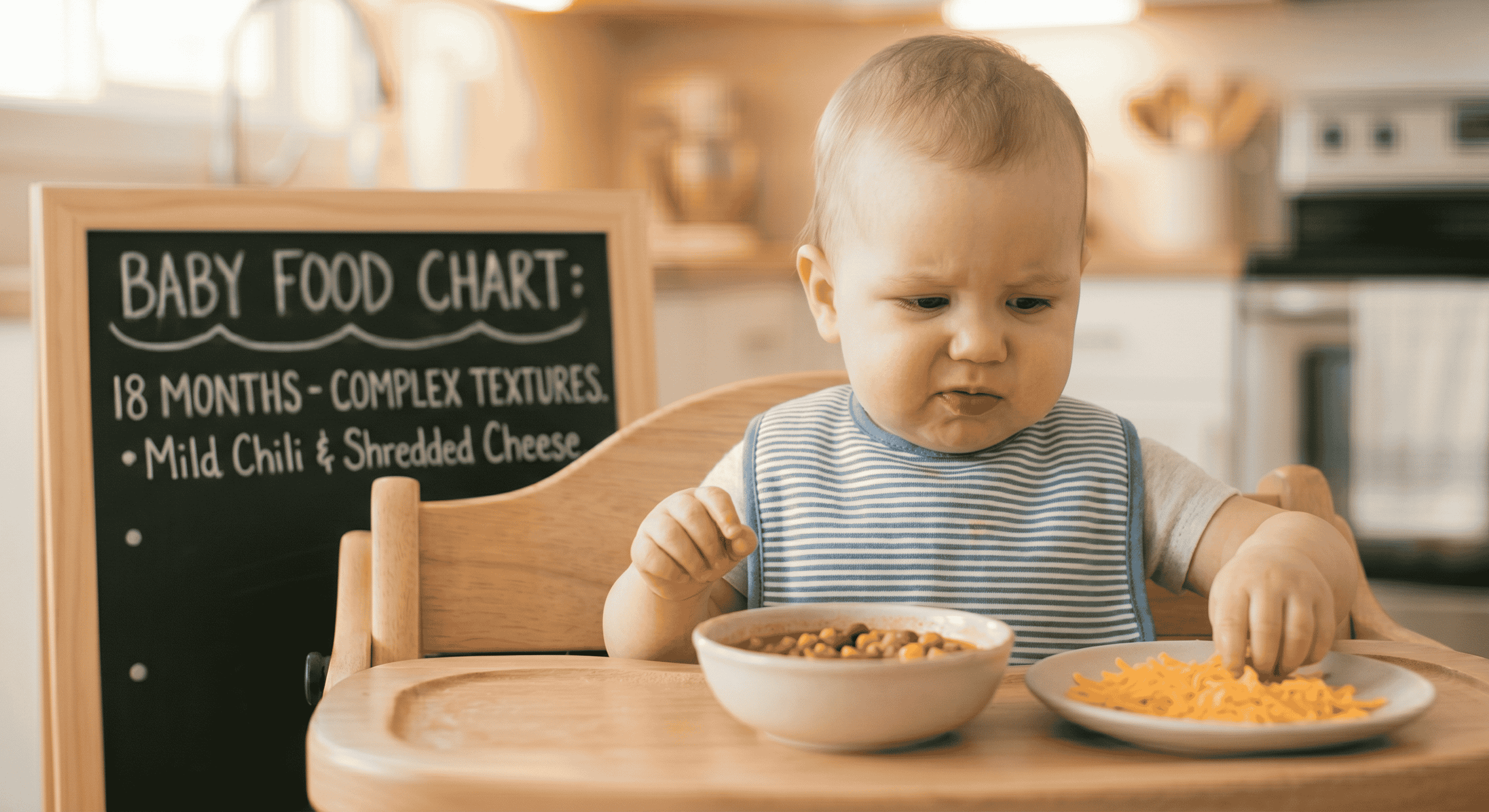
18 Months – Texture and Preference (Complex Flavours)
At 18 months, the toddler looks increasingly mature and is sitting at a child-sized wooden table in the same cosy kitchen. The food is now complex in flavour and texture. A small bowl holds mild turkey chili with visible beans and small corn pieces, served alongside shredded cheddar cheese. The toddler is actively selecting the cheese, showing clear preference. The chalkboard remains, reading: "BABY FOOD CHART: 18 MONTHS - COMPLEX TEXTURES. Mild Chili & Shredded Cheese."
What is changing at 18 months
Physical development at 18 months
Most 18-month-olds are walking confidently and beginning to run. This increased activity raises calorie needs slightly compared to a sedentary 12-month-old. The motor skills at mealtimes are also advancing:
- Spoon use: Can bring a preloaded spoon to mouth with reasonable accuracy. Offer preloaded spoons alongside finger foods at every meal.
- Cup drinking: Can drink from a sippy cup or open cup without help; some spilling is still expected.
- Pincer grasp: Refined — can pick up very small pieces reliably.
- Molar development: First molars typically present by 16–18 months, improving chewing significantly. Second molars arrive around 20–30 months.
Nutritional picture at 18 months
The nutritional targets at 18 months are similar to 12 months but with slightly higher calorie needs:
- Calories: 1,000–1,100 per day
- Iron: 7 mg/day — remains the most commonly deficient nutrient
- Calcium: 700 mg/day — 2–3 dairy servings easily meets this
- Protein: 13 g/day — met by most varied diets
- Vitamin D: 600 IU/day — supplement if dietary sources are insufficient
- Whole milk: 16–24 oz per day maximum
18-month toddler food chart
This chart shows a recommended daily structure. Adjust timing by 30–60 minutes based on your toddler's wake time and nap schedule.
| Time | Meal/Snack | Example foods | Portions |
|---|---|---|---|
| 7:00–7:30 am | Breakfast | Iron-fortified oatmeal with whole milk + quartered strawberries + thin nut butter swirl | 3–4 tbsp oatmeal, 2 tbsp fruit |
| 9:30–10:00 am | Morning snack | Full-fat yogurt + soft fruit (banana, mango, or blueberries quartered) | 4 tbsp yogurt, 2 tbsp fruit |
| 12:00–12:30 pm | Lunch | Soft pasta with minced beef sauce + steamed broccoli + water | 2–3 tbsp each item |
| 1:00–2:30 pm | Nap | — | — |
| 3:00–3:30 pm | Afternoon snack | Cheese cubes + whole grain crackers + quartered grapes | 2–3 small cubes, 3 crackers, 4–5 quarters |
| 5:30–6:00 pm | Dinner | Shredded chicken or salmon + mashed sweet potato + soft peas + whole milk | 2 tbsp protein, 3 tbsp veg, 4–6 oz milk |
Best foods for an 18-month-old
Iron-rich foods (critical — prioritise at every main meal)
Animal sources (haem iron — most efficient):
- Minced beef or lamb mixed into pasta, rice, or vegetable dishes
- Shredded chicken thigh (more iron than breast meat)
- Canned sardines (mash and mix into scrambled egg or pasta)
- Salmon flakes
- Scrambled or hard-boiled egg
Plant sources (non-haem iron — pair with vitamin C):
- Iron-fortified toddler oatmeal or cereal — the single most iron-dense food per serving
- Lentils (red lentils cook soft and mix into sauces easily)
- Chickpeas (soft-cooked, lightly mashed)
- Black beans (mashed into quesadilla or tacos)
- Tofu (silken or soft, cubed or mashed)
Vitamin C boosters to pair:
- Quartered strawberries alongside oatmeal
- Tomato-based sauce with pasta
- Capsicum pieces alongside any legume dish
- Broccoli with chicken or fish
Calcium and dairy at 18 months
Dairy provides calcium (700 mg/day needed) and, at this age, still the fat needed for brain development.
| Dairy food | Daily target | Portion per serving |
|---|---|---|
| Whole cow's milk | 16–24 oz per day maximum | 4–6 oz (120–180 ml) per occasion |
| Full-fat yogurt | Once daily (optional) | 4 oz (112 g) |
| Soft cheese | Once or twice daily | 1/2 to 1 oz (15–30 g) |
Grains and energy
Whole grains provide iron (when fortified), fibre, and B vitamins alongside their primary role as calorie and carbohydrate source.
- Whole grain oatmeal (iron-fortified)
- Whole grain pasta (look for fortified varieties)
- Soft-cooked brown rice or quinoa
- Whole grain bread or toast
- Whole grain crackers or rice cakes
Vegetables
At 18 months, aim for 2–3 servings of vegetables per day. Always soft-cooked (not raw) except for naturally soft vegetables (avocado, soft tomato).
Rotating vegetable suggestions:
- Week 1: Broccoli, sweet potato, peas
- Week 2: Roasted carrot, spinach (cooked, mixed in), capsicum
- Week 3: Butternut squash, green beans, courgette
- Week 4: Cauliflower, beetroot (cooked, diced), corn (off cob, soft-cooked)
Rotation builds variety and maximises micronutrient coverage — different coloured vegetables provide different vitamins.
Fruits
Aim for 2 servings of whole fruit per day. Limit 100% fruit juice to 4 oz per day maximum.
- Ripe banana (coins or mashed)
- Quartered grapes or blueberries
- Sliced strawberries
- Ripe mango cubes
- Soft ripe peach (skin removed)
- Kiwi cubes (excellent vitamin C)
- Soft-cooked apple or pear
Daily portion summary for 18 months
| Food group | Servings per day | 1 serving |
|---|---|---|
| Grain/starch | 3–4 | 2–3 tbsp cooked; 1/2 slice bread |
| Vegetables | 2–3 | 2–3 tbsp cooked vegetables |
| Fruit | 2 | 2 tbsp soft fruit; 1/4 banana |
| Protein (meat/egg/legume) | 2 | 2 tbsp shredded meat, 1/2 egg, 2 tbsp legumes |
| Dairy | 2–3 | 4–6 oz milk; 4 oz yogurt; 1 oz cheese |
| Healthy fats | At most meals | 1/4 avocado; 1 tsp nut butter; drizzle olive oil |
Foods to continue avoiding at 18 months
Even at 18 months, several foods remain unsafe:
- Whole round foods: Grapes, cherry tomatoes, blueberries must be quartered
- Hard raw vegetables: Carrot sticks, celery sticks — still a choking risk; steam until soft
- Whole nuts: Pea-size pieces or smooth nut butter only
- Popcorn: Avoid until age 4
- Large meat chunks: Shred or cut to 1 cm
- Thick nut butter from spoon: Always thin before serving
- Added salt and sugar: Minimal — use herbs, mild spices, lemon
- Cow's milk as a drink beyond 24 oz: Risk of iron deficiency
Building a positive mealtime at 18 months
The 18-month mealtime environment matters as much as the food on the plate.
What supports positive eating at 18 months:
- Consistent meal times (toddlers thrive on predictability)
- Sitting together as a family, eating the same food
- No screens during meals (phone, tablet, TV)
- Allowing mess without removing the food
- Neutral response to rejection ("okay, you don't want that today")
- Offering 2 choices when possible ("broccoli or peas with lunch?")
- Keeping meals to 20–30 minutes
What undermines eating at 18 months:
- Allowing grazing between meals (kills appetite)
- Offering the phone or tablet to get more bites in (creates a distraction eating habit)
- Making a separate "toddler meal" every time something is rejected
- Commenting on food intake ("you haven't eaten much," "you need to eat more")
The 18-month food chart is a framework, not a rulebook. Some days your toddler will eat everything on this list with enthusiasm. Other days they will take two bites of a previously loved food and be done. Both are completely within the range of normal toddler eating. Trust the structure, trust your toddler's hunger signals, and keep offering variety without pressure.
Frequently asked questions
What should an 18-month-old eat in a day?
An 18-month-old should eat approximately 1,000–1,100 calories per day across 3 meals and 2 snacks. Each main meal should include a protein (egg, meat, fish, or legume), a vegetable, a grain, and dairy (milk or yogurt/cheese). Snacks should be nutrient-dense: fruit + dairy or protein + grain.
How much milk should an 18-month-old drink?
16–24 oz of whole milk per day. Do not exceed 24 oz as excess milk displaces iron-rich solid foods and is the primary driver of toddler iron deficiency. Offer milk at meals — not as a between-meal drink. After age 2, switch to low-fat milk.
Can an 18-month-old eat raw fruit and vegetables?
Soft raw fruits (ripe banana, quartered grapes, avocado, very ripe peach) are safe at 18 months. Hard raw vegetables (carrot, apple, celery) remain choking risks until around 24–30 months when all molars are present. Steam, roast, or grate hard vegetables until age 2–3.
What are good iron-rich foods for an 18-month-old?
Best iron-rich foods for 18-month-olds: iron-fortified oatmeal or cereal, minced or shredded red meat (beef, lamb), canned sardines or salmon, scrambled or hard-boiled egg, soft-cooked lentils and chickpeas, tofu, and quinoa. Always pair plant-based iron with a vitamin C source.
How do I handle food rejection at 18 months?
Stay calm and neutral. Remove the plate after 20–30 minutes without comment. Offer the rejected food again at the next meal — track this as an exposure count (toddlers need 8–15 exposures before acceptance). Never force, bribe, or make a separate meal. The picky phase is temporary and resolves with consistent, pressure-free exposure.
What textures should an 18-month-old be eating?
At 18 months, toddlers should be eating most family food textures: soft-cooked vegetables, chopped or shredded meat, cooked legumes, soft bread, pasta, and rice. Avoid hard raw vegetables, whole nuts, and tough chewy meats. All round foods must still be quartered. Most foods should be soft enough to compress between thumb and finger.
Sources & references
- Feeding Toddlers Age 12–24 Months, CDC
- Sample Menu for a One-Year-Old, HealthyChildren.org — AAP
- Iron Deficiency in Toddlers, CDC
- Dietary Guidelines 2020–2025, USDA
- Choking Prevention for Children, AAP
BabyFoodCharts Editorial Team
Reviewed against current pediatric feeding guidance
Our editorial team researches and reviews every guide for accuracy and clarity. This content is educational and is not a substitute for advice from your own pediatrician.
Browse these topics
Related articles
Continue reading
Read next2 Year Old Food Chart: Complete Meal Plan, Portions & Best FoodsRecently updated
Note: BabyFoodCharts provides general educational information. It is not medical advice. Consult your pediatrician before introducing new foods, especially common allergens.