
Growth Resources
Signs Baby Is Ready for Solid Foods: 7 Readiness Checklist
Not sure if your baby is ready to start solid foods? Check all 7 developmental readiness signs recommended by the AAP before introducing purees or finger foods.
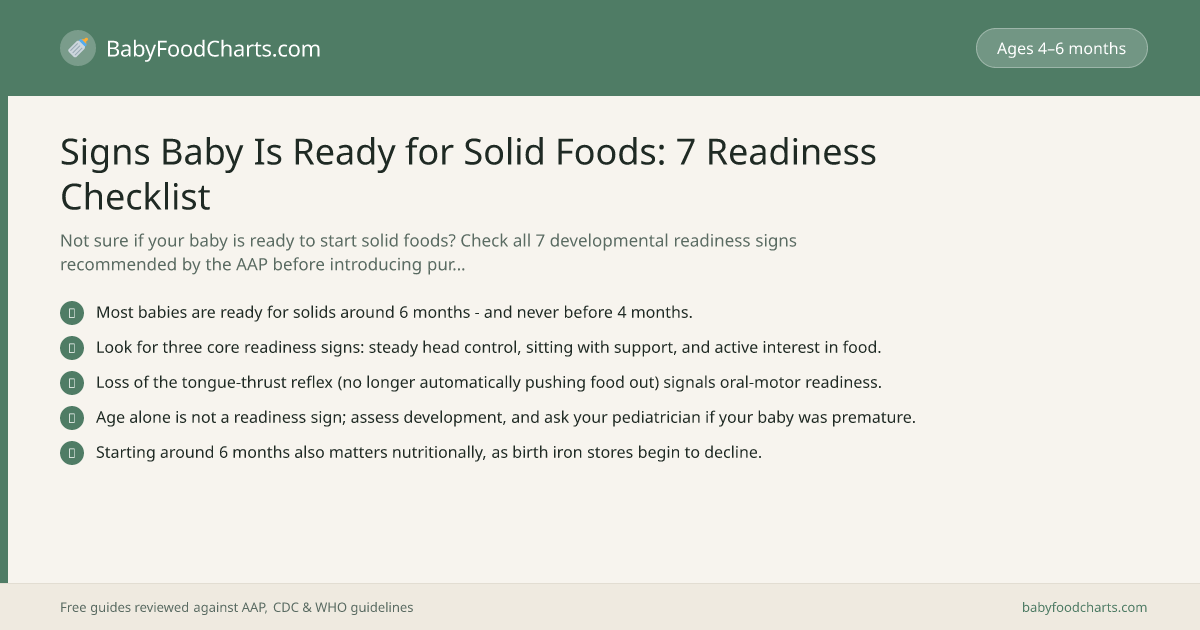

Most babies are ready for solid foods at around 6 months, and the clearest signs are good head control, the ability to sit upright with support, loss of the reflex that pushes food out of the mouth, and genuine interest in eating. Age is only part of the picture, your baby's body needs to be ready too, and every baby develops at a slightly different pace.
The core readiness signs
Pediatric guidance points to a handful of developmental signs that tell you your baby's mouth, neck, and trunk are ready to handle solid food safely. Look for most of these together rather than relying on any single one.
| Readiness sign | What it looks like |
|---|---|
| Head and neck control | Holds head steady and upright without bobbing |
| Sits with support | Stays upright in a high chair or with light support |
| Tongue-thrust fades | No longer automatically pushes food back out |
| Reaches for food | Grabs at your plate and brings objects to mouth |
| Opens mouth for spoon | Leans in and opens up when food approaches |
Head and neck control
Before solids, your baby needs to hold their head steady on their own. Swallowing safely depends on a stable head and neck, so a baby whose head still wobbles is usually not quite ready.
Sitting with support
Your baby does not need to sit fully unassisted, but they should be able to sit upright with some support, in a high chair or propped securely. An upright posture helps food travel down rather than causing gagging or choking.
Loss of the tongue-thrust reflex
Young infants have a protective reflex that automatically pushes objects out of the mouth. As this fades, usually somewhere between 4 and 6 months, your baby can move food to the back of the mouth and swallow it instead of spitting everything out.
Interest in food
A baby who watches you eat, reaches for your plate, and opens their mouth when a spoon comes near is signaling curiosity. This interest, combined with the physical signs above, is a strong cue that the time is approaching.
Why around 6 months?
Major pediatric organizations generally recommend introducing solids at about 6 months. By this age, most babies have the oral-motor skills to manage food, and breast milk or formula alone may no longer fully meet their needs, especially for iron and zinc, which babies begin to require from food sources.
Why not before 4 months?
Starting solids before 4 months is widely discouraged. A young baby's swallowing coordination and digestive system are still maturing, the tongue-thrust reflex is usually still strong, and early solids can displace the nutrition that milk provides. There is also no benefit to starting early, it does not help babies sleep longer, despite the common myth.
Putting it together
Think of readiness as a checklist rather than a birthday. A baby who turns 6 months but cannot yet sit with support or still pushes food out may simply need another week or two. Conversely, a baby showing all the signs a little before 6 months, but not before 4 months, may be ready, with your pediatrician's input.
When you do begin, start slowly. Offer a small amount of a single food once a day, watch how your baby responds, and let them set the pace. Some babies dive in eagerly while others take time to warm up, and both are completely normal.
When to wait a little longer
Hold off and revisit in a week or two if your baby:
- Still has noticeable head wobble or cannot stay upright with support
- Consistently pushes food back out with the tongue
- Seems uninterested or upset by the spoon
- Was born prematurely (discuss adjusted timing with your doctor)
Readiness is a developmental milestone, and like all milestones, it arrives on each baby's own schedule. Watching for these signs, rather than the calendar alone, sets the stage for a calm, confident start to solid foods.
Frequently asked questions
At what age can I start solids?
Most babies are ready for solids around 6 months, and never before 4 months. The exact timing depends on your baby showing developmental readiness signs, so check with your pediatrician.
What are the main signs my baby is ready for solids?
The core signs are good head and neck control, the ability to sit upright with support, loss of the tongue-thrust reflex that pushes food out, and clear interest in what you are eating.
Is age alone enough to start solids?
No. Age is a guide, but your baby should also show physical readiness signs. A baby who turns 6 months but cannot yet hold their head steady may need a little more time.
Why not start solids before 4 months?
Before 4 months a baby's digestive system and oral-motor skills are still developing, and early solids can crowd out the nutrition from breast milk or formula. Most guidance advises waiting.
What is the tongue-thrust reflex?
It is an automatic reflex that pushes objects out of the mouth to protect young infants from choking. As it fades, usually around 4 to 6 months, your baby can move food to the back of the mouth and swallow it.
What food should I offer first?
There is no single required first food. Iron-rich options and single-ingredient purees like iron-fortified cereal, pureed meats, mashed avocado, or banana are common starting points. Ask your pediatrician what fits your baby.
Sources & references
- When, What, and How to Introduce Solid Foods, Centers for Disease Control and Prevention
- Starting Solid Foods, American Academy of Pediatrics
- Your baby's first solid foods, NHS
BabyFoodCharts Editorial Team
Reviewed against current pediatric feeding guidance
Our editorial team researches and reviews every guide for accuracy and clarity. This content is educational and is not a substitute for advice from your own pediatrician.
Browse these topics
Related articles
Continue reading
Read nextBaby Growth Tracking: Understanding Weight and Height PercentilesRecently updated
Note: BabyFoodCharts provides general educational information. It is not medical advice. Consult your pediatrician before introducing new foods, especially common allergens.